

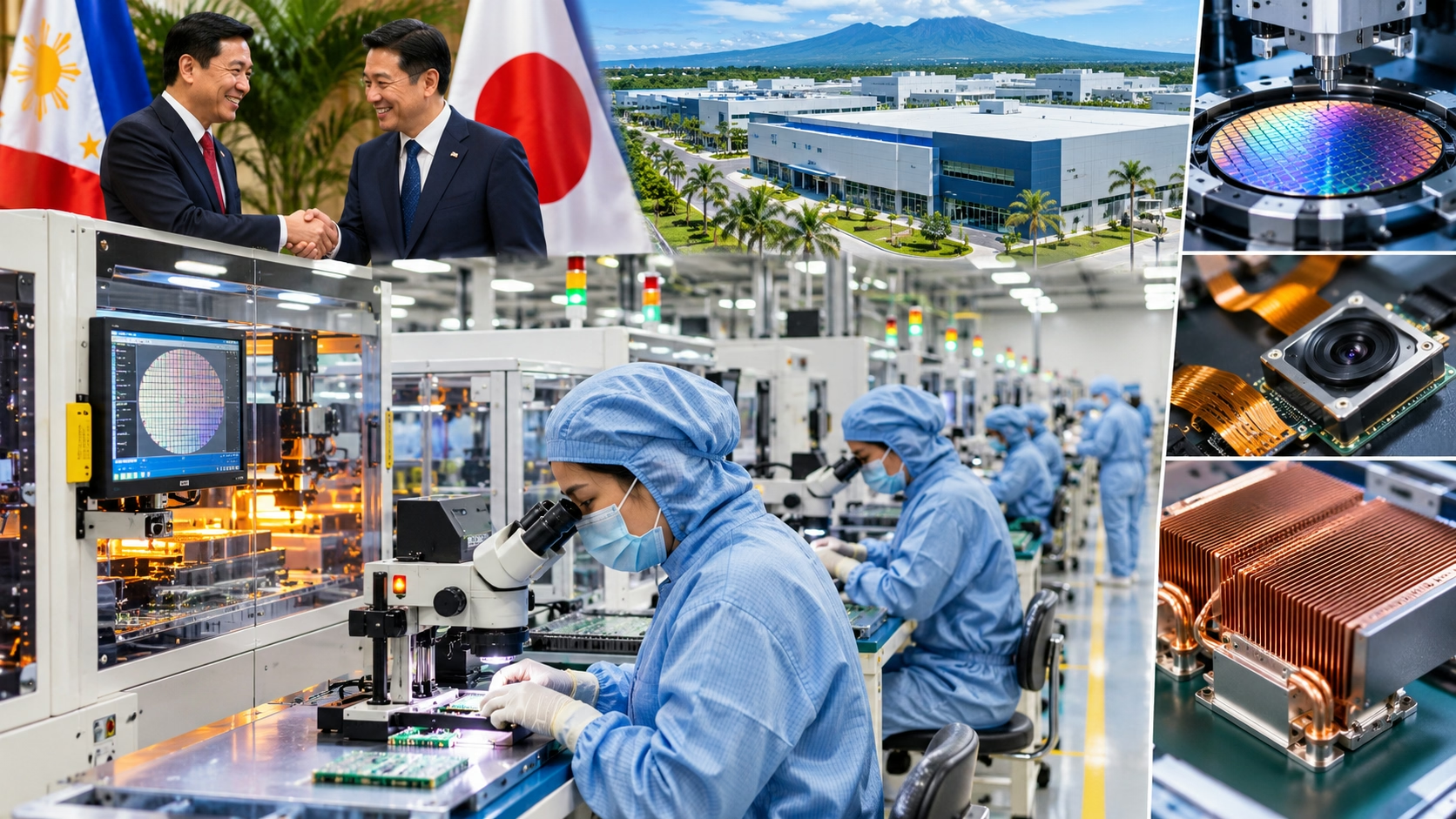
The Philippines is no longer pitching itself merely as a low-cost assembly destination. In 2026, a wave of Japanese capital is testing whether the country can become a genuine mid-tier node in the global semiconductor and electronics supply chain—one that handles advanced packaging, thermal management, and precision components rather than just final assembly.
The Japanese Anchor Investments
In late May 2026, President Ferdinand Marcos Jr.’s state visit to Japan produced approximately ₱56.3 billion in expected investments spanning shipbuilding, advanced electronics, and semiconductor back-end manufacturing. MinebeaMitsumi alone committed ₱25 billion to expand semiconductor back-end operations, battery protection modules for hyperscale data centers, and optical image stabilization technologies, with 3,000 additional jobs expected across Cebu, Batangas, and Bataan. Sumitomo Electric followed with a ₱4.3 billion flexible printed circuit facility in Cabuyao, Laguna, targeting commercial operations by April 2027.
These are not greenfield experiments. MinebeaMitsumi already employs roughly 22,000 workers in the Philippines and has accumulated about ₱53 billion in local investments as of March 2026. The new commitments deepen existing industrial relationships rather than creating isolated enclaves—a distinction that matters for supplier development and skills transfer.
PEZA Approvals Confirm Broad Momentum
The macro signal is equally telling. The Philippine Economic Zone Authority approved 157 new and expansion projects worth ₱140.688 billion in the first half of 2026, a 94.42% increase from ₱72.36 billion in the same period the previous year. Electronics manufacturing accounted for the largest share of approved investments, followed by ecozone development and IT-BPM activities. That composition suggests nearshoring interest is not confined to one vertical but is spreading across the industrial base.
The incentive architecture behind this surge is deliberate. CREATE MORE links tax incentives to investment capital, industry tier under the Strategic Investment Priority Plan, and project location, while PEZA-registered enterprises can access enhanced deductions on power costs and industrial land leases of up to 99 years. For a Japanese precision manufacturer weighing Vietnam against the Philippines, those fiscal and tenure terms narrow the gap.
Moving Beyond Back-End Assembly
The strategic question is whether the Philippines can climb the value chain. The government’s semiconductor roadmap targets $110 billion in electronics exports by 2030, with an explicit push into advanced packaging, integrated circuit design, and front-end capabilities. The current investment wave—focused on back-end manufacturing, thermal modules, and flexible circuits—is a foundation, not a finished structure. Whether it leads to design and wafer-level activity depends on whether locators find enough engineering talent and reliable power to justify the next tier of capital expenditure.
What Still Constrains the Bet
The binding constraints are familiar and unresolved. Industrial electricity in the Philippines runs close to 15 US cents per kilowatt-hour, roughly 50% above Indonesia and Vietnam, while logistics costs consume about a quarter of sales. Port congestion has forced carrier booking suspensions, and governance questions around public works spending continue to weigh on investor sentiment. Japanese manufacturers can absorb some of these costs in the short run, but scale-up decisions in 2028 and beyond will hinge on whether the power and logistics penalties narrow.
For now, the combination of treaty-allied security positioning, a 50-year semiconductor assembly history, and a 94% surge in PEZA approvals gives the Philippines a credible claim on nearshoring capital. The next test is execution—turning signed investment pledges into operating fabs, trained technicians, and export volume.







Leave a Reply