

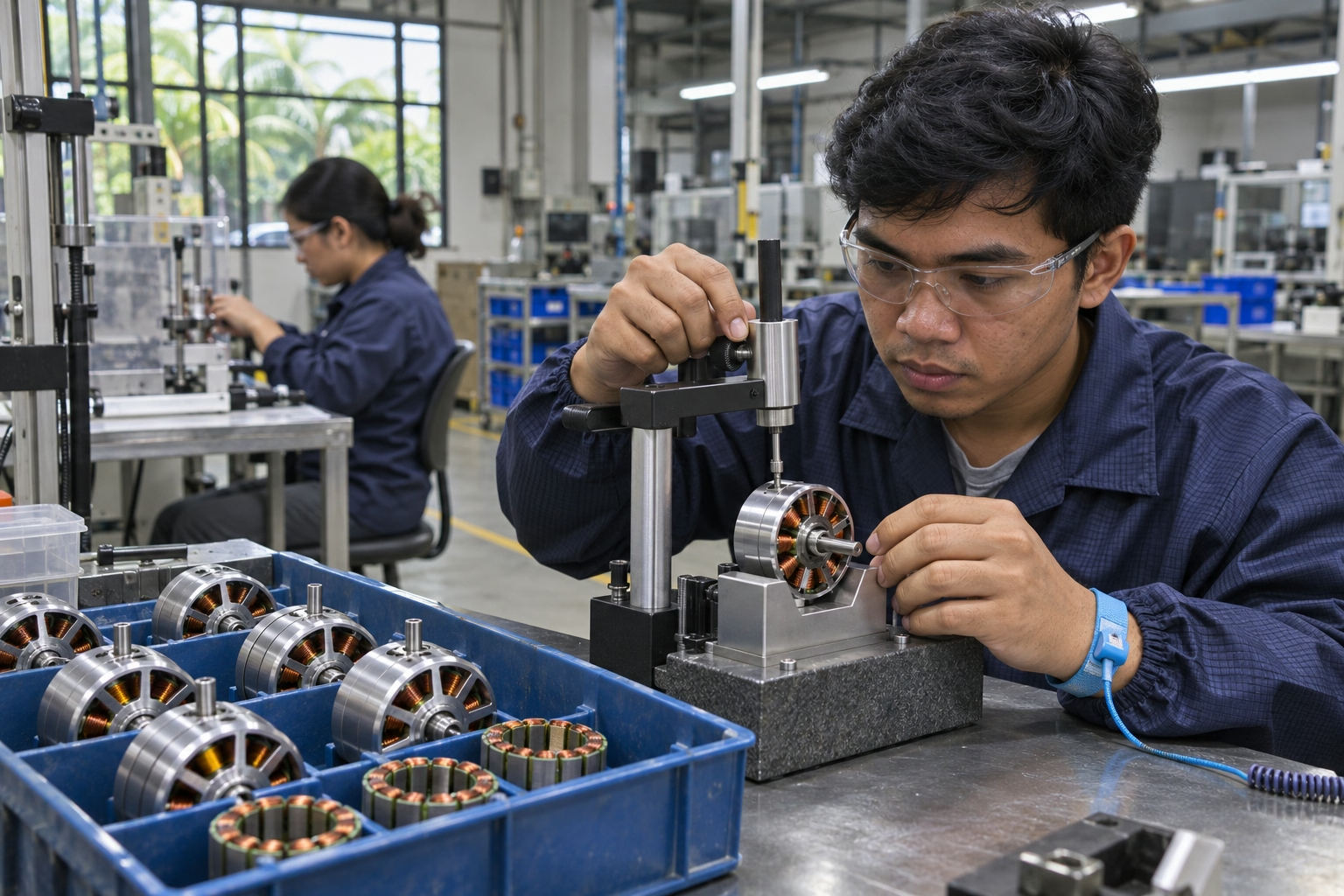
When three Filipino-American engineers decided to build motors for robots and drones, they could have chosen Shenzhen, Vietnam, or Mexico. They picked Biñan, Laguna instead. Atlas Motion Systems, a California-headquartered startup founded by Christian Mochen, Carlo Dela Rosa, and Tom Baron, began production at a 1,500-square-meter PEZA-registered factory inside Laguna Technopark in early 2026. By September, the plant was already churning out 10,000 motors monthly with just 15 technical staff. The company projects 40,000 units per month by December.
Why the Philippines Beat Other Asian Manufacturing Hubs
The decision was not driven by cheap labor. Mochen, a former Tesla quality engineer who worked on Model Y and Cybertruck production lines in Austin, told the Philippine News Agency that the Philippines possesses “a super robust culture around component manufacturing” that took decades to build. This “tribal knowledge”—the accumulated, often undocumented expertise of factory workers and process engineers—proved decisive. Atlas needed to move fast. Mochen noted that competitors in the United States have operated for years, yet Atlas already outputs more motors per month than they do.
The company raised $11.5 million from US investors including Greycroft and Also Capital, and has used PEZA’s regulatory support to navigate incentives and exemptions. For global robotics supply chains, the Laguna facility is not a cost-arbitrage play. It is a speed-to-market play.
What This Means for Robotics Startups Eyeing Southeast Asia
Atlas Motion Systems demonstrates that the Philippines can compete for high-mix, precision component manufacturing—not just back-office services or basic assembly. The presence of Texas Instruments, which produces analog microchips and real-time processors for robotics, and Epson Precision Philippines, which will manufacture SCARA and six-axis industrial robots starting 2027, suggests an emerging cluster around Laguna and nearby industrial corridors. For founders building robotics hardware, the signal is clear: the Philippines offers a rare combination of English-speaking technical talent, PEZA-administered regulatory efficiency, and a manufacturing culture that predates the current automation wave.












Leave a Reply