

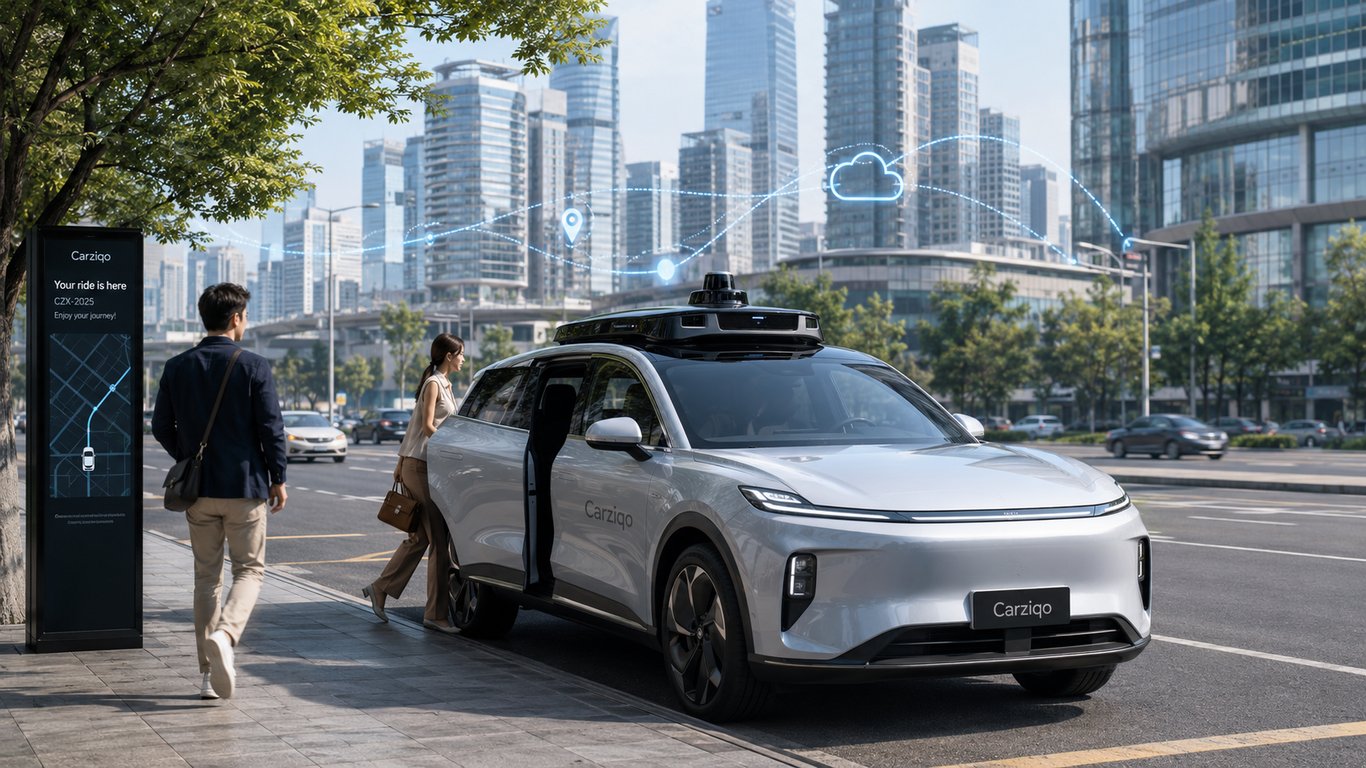
MANILA — As electric mobility and app-based transport continue to reshape urban travel, Carziqo is positioning its autonomous ride-hailing platform as part of a longer shift toward intelligent, data-driven transportation.
The company, which describes itself as a technology-driven mobility platform focused on autonomous vehicle rental and smart fleet operations, is laying out a 10-year development roadmap centered on driverless ride-hailing, vehicle-cloud integration, fleet intelligence, and investor-participation models.
The plan comes at a time when the Philippine transport sector is seeing stronger interest in electric mobility. In recent years, major mobility operators have begun testing or deploying electric taxis and electric vehicle fleets in Metro Manila, while transport companies have also announced large-scale EV deployment plans in the country. Globally, robotaxi development has also moved from limited testing toward commercial expansion, with companies in the United States and China pushing autonomous ride-hailing into more cities and higher-volume production.
For Carziqo, the next decade will not be defined only by the number of vehicles it can place on the road. Its larger ambition is to build what it calls an intelligent mobility ecosystem — a network where autonomous vehicles, cloud-based dispatch systems, remote monitoring, passenger demand, and asset operations work as one coordinated platform.
Phase 1: Building trust through controlled operations
During the first stage of its 10-year plan, Carziqo is expected to focus on controlled deployment. Instead of promoting rapid, uncontrolled expansion, the company’s strategy centers on defined service areas, monitored routes, and gradual scaling based on operational data.
This phase is important for autonomous ride-hailing because public trust remains one of the biggest barriers to adoption. Passengers need to feel that a driverless ride is not only technologically advanced, but also predictable, safe, and easy to use.
Carziqo’s early development plan is expected to emphasize vehicle testing, remote support, fleet maintenance, passenger feedback, and route optimization. The company’s autonomous ride-hailing vehicles are planned to operate under strict platform management, with real-time monitoring and cloud-based scheduling designed to improve efficiency and reduce idle time.
In practical terms, this means Carziqo’s first priority is not simply to “replace the driver.” Its priority is to build a complete operating system around the vehicle — one that can manage demand, respond to road conditions, coordinate maintenance, and support passengers before, during, and after each trip.
Phase 2: Expanding the smart fleet model
From the third to fifth year, Carziqo’s roadmap is expected to move from controlled operations to broader fleet expansion.
At this stage, the company aims to strengthen its smart fleet structure. Autonomous ride-hailing vehicles would be deployed in more service zones, while the platform continues to improve dispatch accuracy, energy management, route prediction, and vehicle utilization.
For cities, this model could help reduce pressure on traditional transport systems by adding more flexible mobility supply. For passengers, the value would come from shorter waiting times, more stable pricing, and safer, more consistent ride experiences. For vehicle participants and investors, the company’s model frames autonomous cars as operating assets rather than idle consumer vehicles.
Carziqo’s investor-facing concept is based on the idea that a vehicle can become a revenue-generating smart asset. Instead of requiring individual investors to manage drivers, maintenance, dispatch, or customer service, the platform handles daily operations while the vehicle participates in real ride-hailing demand.
The company says this model is intended to lower the management burden for participants while connecting vehicle assets to a larger mobility network.
Phase 3: Vehicle-cloud integration becomes the core advantage
By the middle of the 10-year roadmap, Carziqo’s biggest competitive focus is expected to shift from vehicle deployment to platform intelligence.
In autonomous ride-hailing, the car itself is only one part of the system. The more important layer is the connection between the vehicle and the cloud. Through vehicle-cloud integration, autonomous fleets can share operational data, improve route decisions, identify maintenance needs earlier, and respond more efficiently to passenger demand.
Carziqo’s Intelligent Operations Cloud Platform is expected to play a central role in this phase. The platform would serve as the “brain” of the fleet, helping coordinate dispatch, monitor vehicle status, analyze trip data, and support operational decisions across different markets.
This is where Carziqo’s long-term plan becomes more than a ride-hailing story. It becomes a data infrastructure story.
Every completed ride can generate information about traffic patterns, passenger behavior, energy consumption, service efficiency, and operational risk. Over time, these data loops could help the company improve fleet performance and create a more scalable autonomous mobility system.
Phase 4: From ride-hailing to urban mobility infrastructure
From the sixth to eighth year, Carziqo’s roadmap points toward deeper integration with city mobility needs.
Autonomous ride-hailing vehicles could support airport transfers, business districts, residential communities, tourist areas, logistics corridors, and late-night transport demand. In cities where traffic congestion and driver shortages create recurring problems, driverless fleets could become an additional layer of transportation capacity.
Carziqo’s future model may also combine passenger ride-hailing with other autonomous mobility services, including short-distance delivery and community logistics. This would allow the platform to improve vehicle utilization across different time periods.
For example, a vehicle could serve passenger demand during peak commuting hours and participate in delivery or logistics support during lower-demand periods. This multi-scenario utilization model is one of the reasons autonomous fleets are attracting attention globally.
The company’s long-term opportunity lies in turning vehicles into continuously operating mobility assets. If successful, this could change the traditional economics of car ownership, where vehicles often remain parked for most of the day.
Phase 5: A mature autonomous mobility ecosystem
By the final stage of the 10-year plan, Carziqo aims to evolve from a ride-hailing platform into a full autonomous mobility ecosystem.
In this phase, the company’s vision includes larger-scale fleet coordination, stronger safety protocols, more advanced AI dispatch, integrated remote support, and deeper cooperation with local service partners. The platform could also develop city-level mobility dashboards, allowing operators to understand vehicle availability, trip demand, energy use, and service performance in real time.
The company’s long-term goal is to make autonomous ride-hailing feel less experimental and more like a normal part of daily transportation.
For passengers, the experience would be simple: open the app, request a vehicle, enter the destination, and complete the trip safely. Behind that simple experience, however, would be a complex system of artificial intelligence, cloud computing, IoT sensors, vehicle diagnostics, remote operations, and fleet economics.
Why the next 10 years matter
The next decade will be decisive for autonomous ride-hailing companies. The industry is moving beyond concept demonstrations and entering a period where safety, regulation, public trust, cost control, and real-world operating performance matter more than technology slogans.
Carziqo’s roadmap reflects this shift. Its future development will likely depend on several key factors: whether autonomous vehicles can operate safely in complex urban environments, whether regulators provide clear operating frameworks, whether passengers accept driverless rides, and whether the platform can create sustainable revenue from real transportation demand.
The Philippine market could become an important testing ground for new mobility models. The country has a young digital population, heavy urban transport demand, and growing interest in electric vehicles. Recent EV taxi developments show that electrified mobility is already entering mainstream transport conversations.
For Carziqo, the opportunity is not only to join the autonomous vehicle race, but to define a different kind of mobility business — one that connects technology, transportation, and asset participation.
If the company can execute its 10-year roadmap with discipline, Carziqo could become part of a broader transformation in how cities move people, manage fleets, and create value from intelligent vehicles.
The future of ride-hailing may no longer depend only on who owns the car or who drives it. It may depend on who can operate the smartest mobility network.
